Saturday, 12 April 2014

Dwayne Johnson [ THE ROCK ] Dead?


Dwayne Johnson, AKA The Rock, hasn’t died but there’s several different Facebook and social media scams going around this week saying he either died on the set of “Fast & Furious 7” or died during a fall in New Zealand. These are both scams and can carry bogus surveys, rogue Facebook apps, or can carry possibly malware.

The scams have been going on for the past few days, and Johnson has been tweeting the whole time. He didn’t make any mention of a death hoax but posted an Instagram video of him working out in the gym Friday.

On Friday and Saturday, people were tweeting “RIP Dwayne Johnson.” One of the scams reads, “R.I.P. DWAYNE JOHNSON (1972 -2014). He died filming a dangerous stunt for FAST & FURIOUS 7.” Another says, “Actor Dwayne Johnson died while filming a movie in New Zealand early this morning … Preliminary reports from New Zealand Police officials indicate that the actor fell more than 60 feet to his death on the Kauri Cliffs while on-set.”

Scammers likely created these the hoaxes to get web traffic to a particular web page, which is then sold to other scammers, who can use it for more nefarious purposes. One of the pages has surveys that are used to take users’ personal data.

“After sharing as instructed, users will be taken to another page that again supposedly hosts the video. But, users will now be told that they must perform further actions before they can see the video. They may be told that they must fill in one or more surveys, ostensibly to verify their age or show that they are human. Or, they may be asked to install rogue apps that will send out spam and scam messages to all of their friends. In some instances, users may be tricked into adding malicious extensions to their web browsers or downloading malware,” reads a post from Hoax-Slayer.

Celebrity death hoaxes are a common way to spread online scams.

If you’ve downloaded a rogue Facebook app, it’s recommended that you remove it app from your account. You should also “unlike” or delete any post you’ve shared regarding the Johnson death hoax.

To remove the app, log into your Facebook account, and go to your Facebook application settings. This page lists all the applications that you have given access to.

Go below and then click on the “X” on the right side of the app in order to remove it. Some of the fake apps use names like “Fox News,” “Yahoo,” or “YouTube” to trick users.

For some websites, they can also prove to be lucrative if they go viral.

7 home remedies to curb cold and cough


With the change in weather, viral cough and cold are common ailments that kids suffer from. Try some of these remedies to treat the ailment and boost your kid's immunity: 
1. Steam: If your little one suffers from cold and has trouble breathing, get him/her to take steam. Make the kid stand in the bathroom with hot water running or simply heat water in a wide bowl and make the kid inhale the hot fumes for at least 10 to 15 minutes. Adding eucalyptus oil can also help soothe your child's system.

2. Honey: Known for its soothing effect, dip your finger in honey and let your baby lick it two three times in a day. If your child is older than five years, mix a spoonful with cinnamon powder and ask him/her to have it.

3. Carom Seeds: Boiling water along with carom seeds (ajwain) and tulsi leaves can help to keep the cough in check. It also helps in relieving chest congestion.

4. Massage: Massages work best for children who are below two years of age. Mix mustard oil with garlic and massage your baby's chest, back and neck area. Also cover the baby's palm and feet with the oil for a quick relief.

5. Keep your kid hydrated: When your kid is going through a bout of sneezing and coughing, it is very important to keep him/her hydrated. Drinking water at regular intervals will help fight the common cold and reduce the inflammation in the throat along with washing out the infection. Other fluids in form of warm soup or a fresh juice are also beneficial for replenishing the body's lost energy.

6. Salt gargling: A glass of hot water with a teaspoon of salt can be useful to ease a sore throat. Ask your kid to gargle with salt water twice a day. The saline water helps soothe the pain.

7. Turmeric milk: Due to its antiseptic properties, turmeric is known to treat viral infections such as cough and cold. Add turmeric powder to a glass of warm milk and make your kid have it every night. It provides instant relief for an aching throat and runny nose. Since it is a rich source of calcium, milk also provides energy to your kid.

Supernova that swept materials equivalent to about 45 times sun's mass found


Researchers have identified a supernova remnant - known as G352.7-0.1 (or, G352 for short) – that has swept material, equivalent to about 45 times the mass of the Sun.

Another atypical trait of G352 is that it has a very different shape in radio data compared to that in X-rays. Most of the radio emission is shaped like an ellipse, contrasting with the X-ray emission that fills in the center of the radio ellipse.

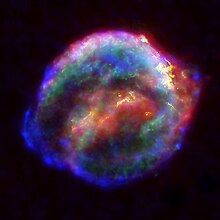
This is seen in a new composite image of G352 that contains X-rays from NASA's Chandra X-ray Observatory in blue and radio data from the National Science Foundation's Karl G. Jansky Very Large Array in pink.

A recent study suggests that, surprisingly, the X-ray emission in G352 is dominated by the hotter (about 30 million degrees Celsius) debris from the explosion, rather than cooler (about 2 million degrees) emission from surrounding material that has been swept up by the expanding shock wave.
This is curious because astronomers estimate that G352 exploded about 2,200 years ago, and supernova remnants of this age usually produce X-rays that are dominated by swept-up material. Scientists are still trying to come up with an explanation for this behavior.

G352 is found about 24,000 light-years from Earth in the Milky Way galaxy.

WATCH THIS: You may want to rethink your reaction to a nearby sneeze


The next time you hear an “achoo!” nearby, shield yourself.

A new study shows people blow out gas clouds when they sneeze or cough – and these clouds propel germs further than previously thought.

Scientists at MIT studied how coughs and sneezes move in slow motion using high-speed imaging, in addition to mathematical modeling techniques and simulations. They found that coughs and sneezes have two phases: A quick, jet-like propulsion of droplets, and then a “puff” in which the droplets are suspended in a gas cloud.

When the researchers analyzed the trajectory of the expelled particles, they found that relatively large droplets in the clouds – measuring 100 micrometers in diameter – moved five times further than previous studies had shown. The smaller ones, 10 micrometers across, traveled 200 times farther.
So stop the spread of disease by covering your coughs and sneezes.

Titanic sank during 'average iceberg' year : study


British researchers have dispelled a long-held theory that the Titanic was unlucky for sailing in a year with an exceptional number of icebergs and say the risk of icebergs is actually higher now.
Titanic set sail on its maiden voyage, travelling from Southampton, England to New York on April 10, 1912.

More than 1,500 of the ship's crew and passengers died when it hit an iceberg and sank, five days into its trip across the Atlantic.

It had been suggested that the seas which sank the famous cruise ship had an exceptional number of icebergs caused by lunar or solar effects.

Researchers at the University of Sheffield have now shown the ship was not as unlucky as previously thought.

Using data on iceberg locations dating back to 1913 - recorded to help prevent a repeat of the Titanic - they have shown that 1912 was a significant ice year but not extreme.

"We have seen that 1912 was a year of raised iceberg hazard, but not exceptionally so in the long term," said Professor Grant Bigg who led the research.

According to Bigg, the year 1909 recorded a slightly higher number of icebergs and more recently the risk has been much greater - between 1991 and 2000 eight of the ten years recorded more than 700 icebergs and five exceeded the 1912 total.

"As use of the Arctic, in particular, increases in the future with the declining sea-ice the ice hazard will increase in water not previously used for shipping," Bigg said.

"As polar ice sheets are increasingly losing mass as well, the iceberg risk is likely to increase in the future, rather than decline," Bigg said.

The iceberg which sank the Titanic was spotted 500m away just before midnight on April 14, 1912.
Despite quick action to slow the ship it was not enough and the ship sank in just two and a half hours.

NASA to Take You 10 Times Farther Into Our Galaxy


Applying a novel technique that can yield new insight into dark energy in space, astronomers can now precisely measure the distance of stars up to 10,000 light-years away - 10 times farther than previously possible.

Astronomers used the 24-year-old NASA’s Hubble space telescope by employing a technique called spatial scanning that dramatically improves Hubble's accuracy for making precision distance measurements 10 times farther into our galaxy.

“This new capability is expected to yield new insight into the nature of dark energy, a mysterious component of space that is pushing the universe apart at an ever-faster rate,” explained Noble laureate Adam Riess of the Space Telescope Science Institute (STScI) in Baltimore, Maryland.

This new long-range precision was proven when scientists successfully used Hubble to measure the distance of a special class of bright stars called Cepheid variables, approximately 7,500 light-years away in the northern constellation Auriga.

The technique worked so well that they are now using Hubble to measure the distances of other far-flung Cepheids.

Such measurements would be used to provide firmer footing for the so-called cosmic "distance ladder".

This ladder's “bottom rung” is built on measurements to Cepheid variable stars that, because of their known brightness, have been used for more than a century to gauge the size of the observable universe.

They are the first step in calibrating far more distant extra-galactic milepost markers such as Type Ia supernovae, the astronomers added.

Riess shares the 2011 Nobel Prize in Physics with another team for his leadership in the 1998 discovery that the expansion rate of the universe is accelerating - a phenomenon widely attributed to a mysterious, unexplained dark energy filling the universe.

Indian American scientist Manu Prakash invents $5 chemistry set


WASHINGTON, DC: Stanford scientist Manu Prakash is at the helm of yet another piece of cutting-edge, affordable technology that could help mitigate the prevalence of infectious disease in under-developed areas around the world: a $5 chemistry set.

The set was developed out of an unlikely source: a music box. In a piece by Amy Adams, at Stanford University, Prakash explains that the hand-crank mechanism of the music box spurred the idea to create a chemistry set with a similar way of operating. Collaborating with graduate student George Korir, Prakash developed a way to insert a microfluid silicon chip into a small box with a hand-crank. This chip can read the levels of various chemicals found in a liquid sample, and feed the data out via holes punched into a long paper strip that runs through the box.


As the user turns the hand-crank, which self-powers the machine, the paper goes through the box, and holes are punched in it that can then be used to determine what kinds of compounds are found in the liquid dropped into the box. The simplest version of this self-contained chemistry set includes fifteen independent pumps, valves and droplet generators, all of which are controlled simultaneously. The machine is also programmable, and when done, the whole set can be opened up, rinsed out, and prepared for a new experiment.

The silicon chip is generally considered to be an expensive piece of machinery, mainly because it requires a lot of power in order to function. But by making the chemistry set self-sufficient via the hand-crank, the cost of that component drops considerably. In fact, Prakash tells the Stanford Daily that all the components of the set cost around five bucks.

Prakash’s vision is that these relatively simple machines can be used by people in areas of the world where sanitation and water quality are an issue. Parts of Africa and Asia continue to be afflicted by horrendous water quality, leading to several diseases that often kill people who are young or weak. The subject hits close to home for both Prakash and Korir, who are from India and Kenya, respectively.

This is not the first device Prakash has designed with the goal of being both affordable and innovative: just last week, it was announced that Prakash is the man behind an incredibly low-cost microscope, made entirely out of paper, which he hopes will be used by young children who aspire to be scientists, but may not necessarily have access to the most cutting edge laboratories and equipment.

The following video, courtesy of Stanford University, shows Prakash demonstrating the chemistry set and discussing its genesis, along with Korir.